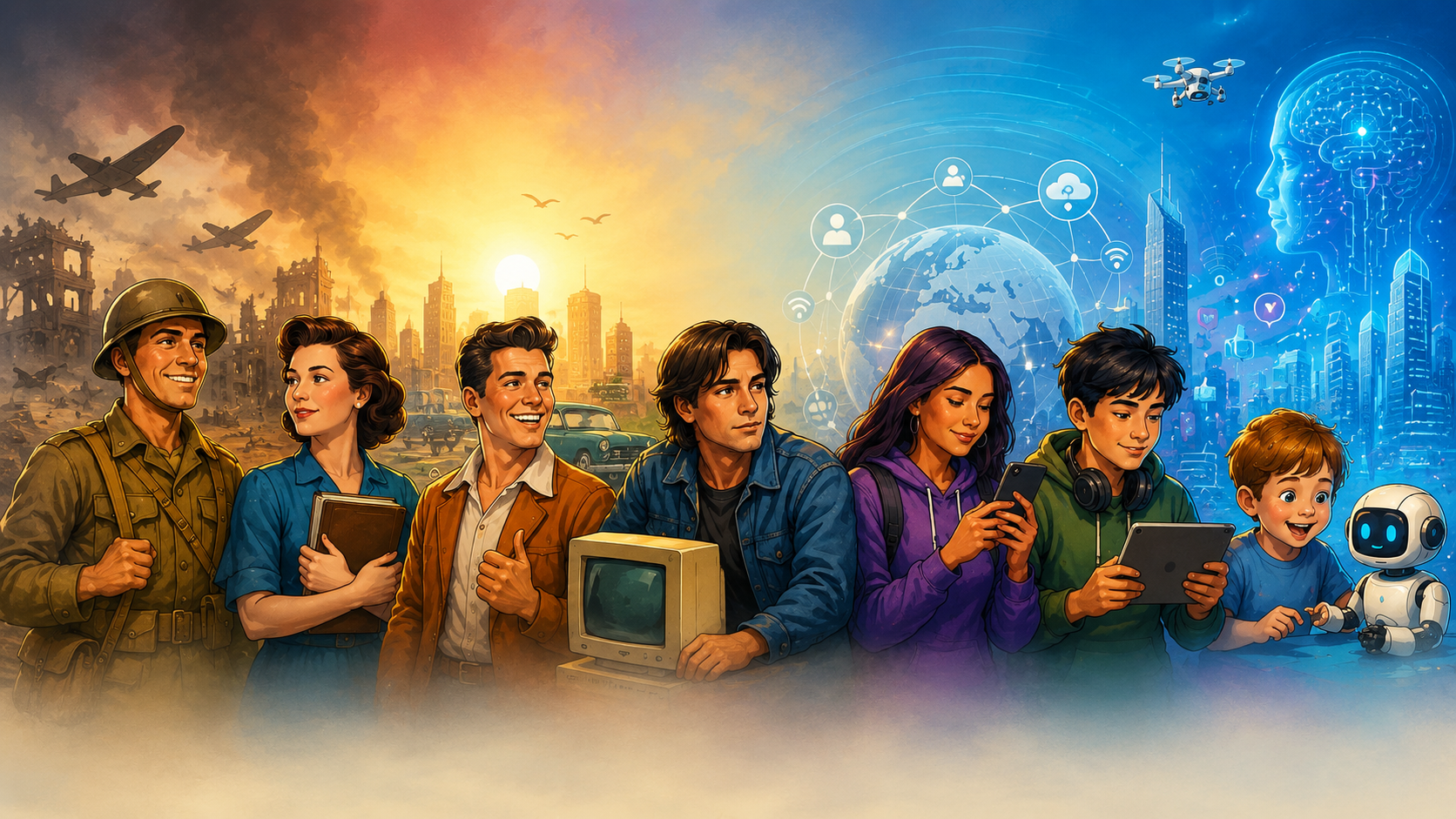
Generations Then and Now: Which Generation Do You Belong To?
You've probably heard people say things like, "They're Gen Z," or "She's a Millennial." Conversations about different generations have become increasingly common—whether on social media, in workplaces, classrooms, or even at family gatherings.
But have you ever wondered what these generations actually mean? How are they defined? And more importantly, which generation do you belong to?
Let's explore the fascinating world of generations in a simple and engaging way.
How Are Generations Defined?
Contrary to popular belief, there is no official government body or international organization that decides when one generation begins and another ends.
Instead, researchers, demographers, sociologists, and cultural analysts study birth years alongside major historical events, technological advancements, economic shifts, and social transformations to identify groups of people who share similar life experiences and values.
Over time, the media, academic research, and popular culture adopt these classifications, gradually making them widely accepted.
In general, a generation spans around 20 to 25 years, although the exact time frame may vary across countries and cultures due to differences in historical, political, and social contexts.
What truly distinguishes one generation from another is not merely the year they were born. Rather, it is the world they grew up in—the technologies they embraced, the events they witnessed, the values they inherited, and the challenges they experienced.
These shared experiences shape their perspectives, behaviors, priorities, and lifestyles, making each generation unique in its own way.
So, let's take a closer look at some of the most influential generations, their approximate birth years, defining characteristics, and the remarkable individuals who represent them.
The Greatest Generation: Forged by Hardship, Remembered for Resilience
Approximate Birth Years: 1901–1927
Current Age (as of 2026): Around 99 years and above
Every generation leaves its mark on history. But some generations don't just witness history—they shape it. The Greatest Generation is one such remarkable group whose resilience, sacrifice, and determination continue to inspire the world.
They grew up during one of the most challenging periods in modern history. Their lives were shaped by the aftermath of World War I, the Great Depression, and the devastation of World War II. Economic hardship, uncertainty, loss, and the struggle for survival were not just stories—they were everyday realities.
Yet, these difficult experiences became the foundation of their greatest strengths. They learned to value hard work, discipline, responsibility, perseverance, and careful spending. Living with limited resources taught them to appreciate what they had and to put the needs of their families, communities, and nations before their own.
This is why historians and researchers often refer to them as "The Greatest Generation." They not only endured some of history's darkest moments but also played a vital role in rebuilding societies and laying the foundations of the modern world.
Their children would later become known as the Silent Generation, inheriting many of the values that defined this extraordinary era—discipline, commitment, and an unwavering work ethic.
Notable Figures of the Greatest Generation
Many influential leaders, humanitarians, and cultural icons were born during this period, including:
Mother Teresa
Bangabandhu Sheikh Mujibur Rahman
Imam Khomeini
John F. Kennedy
Queen Elizabeth II
Ronald Reagan
Marilyn Monroe
At a Glance
Grew up during war and economic hardship
Resilient, disciplined, and responsible
Believed in saving rather than excessive spending
Placed collective well-being above personal gain
Helped rebuild the world after the Second World War
The Silent Generation: The Quiet Builders of a Changing World
Approximate Birth Years: 1928–1945
Current Age (as of 2026): Around 81–98 years
Every generation leaves its own legacy. Some lead great revolutions, while others quietly build the foundations that make those changes possible. The Silent Generation belongs to the latter. Though they rarely sought the spotlight, their dedication, discipline, and sense of responsibility helped shape the modern world.
This generation grew up during the years of World War II and its aftermath—a time marked by economic hardship, political uncertainty, and limited opportunities. Living through such challenging times taught them to be practical, hardworking, and resilient from an early age.
Unlike the Greatest Generation, which often fought to change the system, the Silent Generation generally believed in working within it. They valued stability over conflict, preferred careful planning over taking unnecessary risks, and believed that consistent effort spoke louder than words.
The term "Silent Generation" reflects their modest and reserved nature. Rather than seeking recognition, they focused on fulfilling their responsibilities with patience, discipline, and commitment. Many researchers believe that growing up during war and economic uncertainty shaped their cautious outlook on life.
Despite their quiet nature, this generation made lasting contributions to politics, civil rights, science, arts, business, and culture. They witnessed the decline of colonial empires and the rise of a new global order, experiencing one of the most transformative periods in modern history.
As parents of the Baby Boomer Generation, they passed on values such as hard work, responsibility, perseverance, and respect for discipline—qualities that would influence the generations that followed.
Notable Figures of the Silent Generation
Many influential leaders, artists, and public figures were born during this period, including:
Martin Luther King Jr.
Joe Biden
Saddam Hussein
Ziaur Rahman
Khaleda Zia
Elvis Presley
Amitabh Bachchan
At a Glance
Responsible and hardworking
Disciplined and practical
Preferred stability over unnecessary risks
Believed actions mattered more than recognition
Helped shape the political, economic, and cultural foundations of the modern world
Baby Boomers: A Generation That Dreamed Big and Changed the World
Approximate Birth Years: 1946–1964
Current Age (as of 2026): Around 62–80 years
The end of World War II marked the beginning of a new era. As countries slowly recovered from the devastation of war, hope returned, economies began to grow, and birth rates increased dramatically across many parts of the world. This remarkable population surge gave rise to one of the most influential generations in modern history—the Baby Boomers.
The name "Baby Boomers" comes from this extraordinary rise in births during the post-war years. Growing up in a time of optimism, economic expansion, and improving living standards, they experienced opportunities that many previous generations had never known.
This generation came of age during a period of rapid industrialization, urban growth, expanding mass media, and technological progress. As a result, Baby Boomers became known for their confidence, ambition, and determination to build better lives. They believed that hard work, education, and dedication could open the door to success and a brighter future.
Beyond economic prosperity, Baby Boomers also witnessed—and often led—some of the most significant social and political changes of the twentieth century. Civil rights movements, women's empowerment, cultural transformation, and groundbreaking technological innovations all shaped their worldview and influenced the societies they helped build.
Another defining characteristic of this generation was the rise of consumer culture. Home ownership, automobiles, modern household appliances, and financial success became important symbols of achievement. Because of this, many researchers consider Baby Boomers the driving force behind the growth of today's consumer economy.
Even today, Baby Boomers continue to play influential roles in politics, business, education, and public service. Their decades of experience, leadership, and decision-making continue to shape institutions and inspire younger generations.
Notable Figures of the Baby Boomer Generation
Many globally recognized leaders, innovators, and cultural icons were born during this period, including:
Steve Jobs
Bill Gates
Bill Clinton
Donald Trump
Vladimir Putin
Barack Obama
Princess Diana
Michael Jackson
Sheikh Hasina
Benazir Bhutto
Osama bin Laden
At a Glance
Grew up during the post-war economic boom
Confident, ambitious, and optimistic
Believed in hard work and career success
Helped shape modern consumer culture
Continues to influence politics, business, education, and public life
Generation X: The Pragmatic Bridge Between Two Worlds
Approximate Birth Years: 1965–1980
Current Age (as of 2026): Around 46–61 years
Imagine growing up in a world where handwritten letters were the primary way to communicate, and then witnessing the arrival of personal computers, mobile phones, the internet, and digital technology. That unique journey defines Generation X. Often called "the bridge generation," they connect the traditional world with the digital age.
Generation X came of age during a period of remarkable transformation. They experienced the rise of personal computers, the spread of television, the introduction of email, the first mobile phones, and eventually the internet. Instead of fearing change, they learned to adapt to it—one innovation at a time.
This generation is widely known for being independent, practical, and self-reliant. Rather than seeking attention, they prefer to let their skills, experience, and achievements speak for themselves. In both their personal and professional lives, they value competence, responsibility, and meaningful results.
Rapid social and economic changes also made Generation X remarkably adaptable. They respect traditional values while remaining open to new ideas and emerging technologies. This ability to balance the old with the new has become one of their greatest strengths.
Today, many of the world's business leaders, educators, entrepreneurs, and public administrators belong to Generation X. In many organizations, they play a vital role in connecting the experience of the Baby Boomers with the fresh perspectives of Millennials and Generation Z, helping different generations work together effectively.
Another defining characteristic of Generation X is their commitment to work–life balance. They understand that long-term success is not measured by career achievements alone, but also by personal well-being, family, and the freedom to enjoy life beyond work.
Notable Figures of Generation X
Many influential leaders, entrepreneurs, entertainers, and public figures belong to this generation, including:
Elon Musk
Volodymyr Zelenskyy
Justin Trudeau
Cristiano Ronaldo
Will Smith
Shah Rukh Khan
At a Glance
A bridge between the traditional and digital worlds
Independent, practical, and self-reliant
Adapted successfully to rapid technological change
Values competence, responsibility, and results
Believes in maintaining a healthy work–life balance
Continues to play a key leadership role across business, education, technology, and public service
Millennials (Generation Y): The First Generation of the Digital Revolution
Approximate Birth Years: 1981–1996
Current Age (as of 2026): Around 30–45 years
Imagine growing up in a world where handwritten letters and landline phones were part of everyday life, only to witness the rise of smartphones, social media, and instant global communication. That remarkable journey defines the Millennial Generation, also known as Generation Y.
Millennials came of age during one of the most significant technological transformations in human history. They experienced the arrival of personal computers, the internet, email, mobile phones, social media, and later, smartphones. While they were not born into a fully digital world, they became the first generation to successfully embrace and grow alongside the digital revolution.
One of the defining characteristics of Millennials is their willingness to embrace change. They have readily adopted new technologies, fresh ideas, and evolving ways of working. From entrepreneurship and startups to freelancing and remote work, Millennials have played a leading role in reshaping today's workplace and business culture.
Beyond technology, Millennials are also known for their strong social awareness. They have been vocal about issues such as gender equality, human rights, environmental sustainability, diversity, and mental health. For them, success is measured not only by financial achievement but also by personal fulfillment, meaningful work, and a healthy balance between career and life.
In Bangladesh, Millennials hold a unique place in history. They are the first generation to grow up entirely in an independent nation while witnessing the country's rapid economic development and digital transformation. Many who spent their childhood in the 1990s proudly identify themselves as "90s Kids." Their rare experience of having an analog childhood and a digital adulthood gives them a perspective unlike any generation before them.
Today, Millennials are driving innovation across technology, business, media, education, entrepreneurship, and the creative industries. Standing at the crossroads of experience and innovation, they continue to shape the future while building on the lessons of the past.
Notable Figures of the Millennial Generation
Many globally recognized leaders, athletes, entrepreneurs, and public figures belong to this generation, including:
Mark Zuckerberg
Lionel Messi
Cristiano Ronaldo
Serena Williams
Shakib Al Hasan
Prince William
Kim Jong Un
At a Glance
Witnessed the transition from the analog world to the digital age
Adapted quickly to new technologies and innovation
Ambitious, creative, and open to change
Helped popularize entrepreneurship, startups, freelancing, and remote work
Strong advocates for equality, diversity, sustainability, and mental well-being
Values meaningful work, personal growth, and a healthy work–life balance
Generation Z: The First True Digital Natives
Approximate Birth Years: 1997–2012
Current Age (as of 2026): Around 14–29 years
Imagine growing up in a world where smartphones, high-speed internet, social media, and artificial intelligence have always been part of everyday life. That is the reality of Generation Z, often known simply as Gen Z—the first generation to be truly born into the digital age.
Unlike previous generations that gradually adapted to technology, Gen Z has never known a world without it. Whether it's learning, communicating, finding information, or expressing ideas, digital platforms are a natural part of their daily lives. With just a few taps on a screen, they can connect with people across the globe and stay informed about events happening almost anywhere in real time.
But Gen Z is much more than a tech-savvy generation. They are also known for their strong social awareness. Issues such as mental health, climate change, human rights, gender equality, diversity, and social justice matter deeply to them. They are confident in expressing their opinions and are often willing to speak up for causes they believe in.
This generation has also grown up during a time of global uncertainty. Economic challenges, political conflicts, climate crises, and especially the COVID-19 pandemic have had a profound impact on their education, social lives, and career expectations. These experiences have made them more adaptable, resilient, and conscious of the importance of emotional well-being.
When it comes to careers, Gen Z has a different perspective from many previous generations. They are looking for more than just a stable paycheck. They value meaningful work, continuous learning, creativity, flexible work environments, and a healthy balance between professional and personal life. Many are also drawn to entrepreneurship, content creation, freelancing, and opportunities within the digital economy.
In Bangladesh, Generation Z is already making its presence felt. From technology and innovation to education, entrepreneurship, and civic engagement, young people from this generation are bringing fresh ideas, challenging traditional thinking, and contributing to positive social change.
Generation Z is not simply preparing to lead the future—they are already helping to shape the present.
Notable Figures of Generation Z
Many young people from this generation have already made a remarkable impact on the world, including:
Greta Thunberg
Malala Yousafzai
Kylian Mbappé
Jung Kook (BTS)
At a Glance
The first generation to grow up entirely with smartphones and the internet
Digitally native, creative, and highly adaptable
Globally connected and comfortable in the online world
Passionate about mental health, climate action, equality, and social justice
Interested in innovation, entrepreneurship, and lifelong learning
Already playing an active role in shaping today's world, not just tomorrow's
Generation Alpha: The First Children of the AI Era
Approximate Birth Years: 2013–2024 (Some researchers place the starting year between 2010 and 2012.)
Current Age (as of 2026): Around 2–13 years
Imagine being born into a world where artificial intelligence (AI), smart devices, cloud technology, robots, and virtual experiences are not futuristic ideas but part of everyday life. That is the world of Generation Alpha—the first generation to grow up entirely in the age of AI.
For Generation Alpha, technology is more than just a tool. It is woven into the way they learn, play, communicate, and explore the world. Many of these children had a digital presence even before they were born, as parents shared ultrasound images and family moments online. From their earliest years, they have been surrounded by smartphones, tablets, streaming platforms, online learning, and AI-powered applications.
As a result, Generation Alpha is expected to learn, think, and solve problems differently from any generation before them. With information available at their fingertips, they are growing up in an environment that encourages curiosity, creativity, and continuous learning.
However, growing up in a highly connected world also brings new challenges. Screen time, online safety, digital privacy, mental well-being, and maintaining meaningful face-to-face relationships have become important concerns for parents, teachers, and policymakers. Preparing this generation for the future means teaching them not only how to use technology, but also how to use it wisely, responsibly, and ethically.
Education is also evolving alongside them. Traditional memorization is gradually giving way to critical thinking, creativity, collaboration, problem-solving, and digital literacy. Many of the careers Generation Alpha will pursue may not even exist today, making adaptability and lifelong learning more important than ever.
In Bangladesh, Generation Alpha is growing up in an increasingly digital society. From online classrooms and smart devices to AI-assisted learning, technology is becoming part of everyday education. At the same time, families, schools, and communities have an important responsibility: to ensure that children develop not only digital skills but also empathy, resilience, creativity, and strong human values.
Generation Alpha is likely to become the first generation to live and work alongside artificial intelligence as an everyday partner. Their greatest challenge—and greatest opportunity—will be using technology to build a future that is not only smarter but also more inclusive, sustainable, and deeply human.
What We Know About Generation Alpha
Generation Alpha is still in childhood and early adolescence, so it is too early to define all of their long-term characteristics. However, researchers believe that their natural familiarity with technology, rapid learning abilities, and global connectedness will significantly influence the future of education, work, and society.
At a Glance
The first generation born entirely in the age of artificial intelligence
Growing up with smart devices and advanced digital technology
Expected to become highly creative, adaptable, and lifelong learners
Facing new challenges related to digital well-being, online safety, and privacy
Preparing for careers and industries that are still emerging
Likely to shape a future where humans and AI work together
Conclusion: Generations Change, but the Legacy Lives On
Every generation has its own story.
One generation rebuilt a world shattered by war. Another quietly carried the responsibility of keeping society stable. Some fueled economic growth and industrial progress, while others led the digital revolution. Today, young people are shaping a connected world through technology and innovation, and the children of Generation Alpha are growing up in an era where humans and artificial intelligence will work side by side.
Generational differences should never divide us. Instead, they remind us that every generation inherits the dreams, values, and lessons of those who came before. Each faces its own challenges, leaves its own mark, and passes on new opportunities to the next.
Whether we are Generation X, Millennials, Generation Z, or Generation Alpha, we are all part of the same human story. We may have grown up in different worlds, but we share the same hope—to build a future that is more peaceful, more just, more innovative, and more compassionate.
Technology will continue to evolve. New inventions will reshape the way we live, work, and learn. But one truth will always remain: technology may transform generations, but it is human values that sustain civilization. Kindness, integrity, creativity, empathy, and a willingness to learn from one another will always matter more than any machine.
"Generations change. Technology evolves. The world keeps moving forward. But the generations that inspire hope, strengthen humanity, and leave the world better than they found it are the ones history remembers the most."
So perhaps the most important question is not,
"Which generation do you belong to?"
The real question is,
"What kind of legacy will your generation leave behind?"
Because in the end, history does not remember generations simply by the years they were born. It remembers them by the lives they touched, the values they upheld, and the future they helped create.